Documents
In Documents Seller, a document is a product listing for a digital download, such as an ebook, a template, or a software package. The document controls what customers see in your storefront, what they pay, and which file they receive. Categories organize the listings so customers can browse them.
Each document delivers one file. To offer several files as a single product, such as PDF and EPUB editions of an ebook, put them in a ZIP archive and use that archive as the download. Create separate documents if customers should be able to buy or download each edition individually.
Create a document
- Upload the file you want customers to receive and create at least one published category for the listing.
- In the Joomla administrator, go to Documents Seller → Documents and click New.
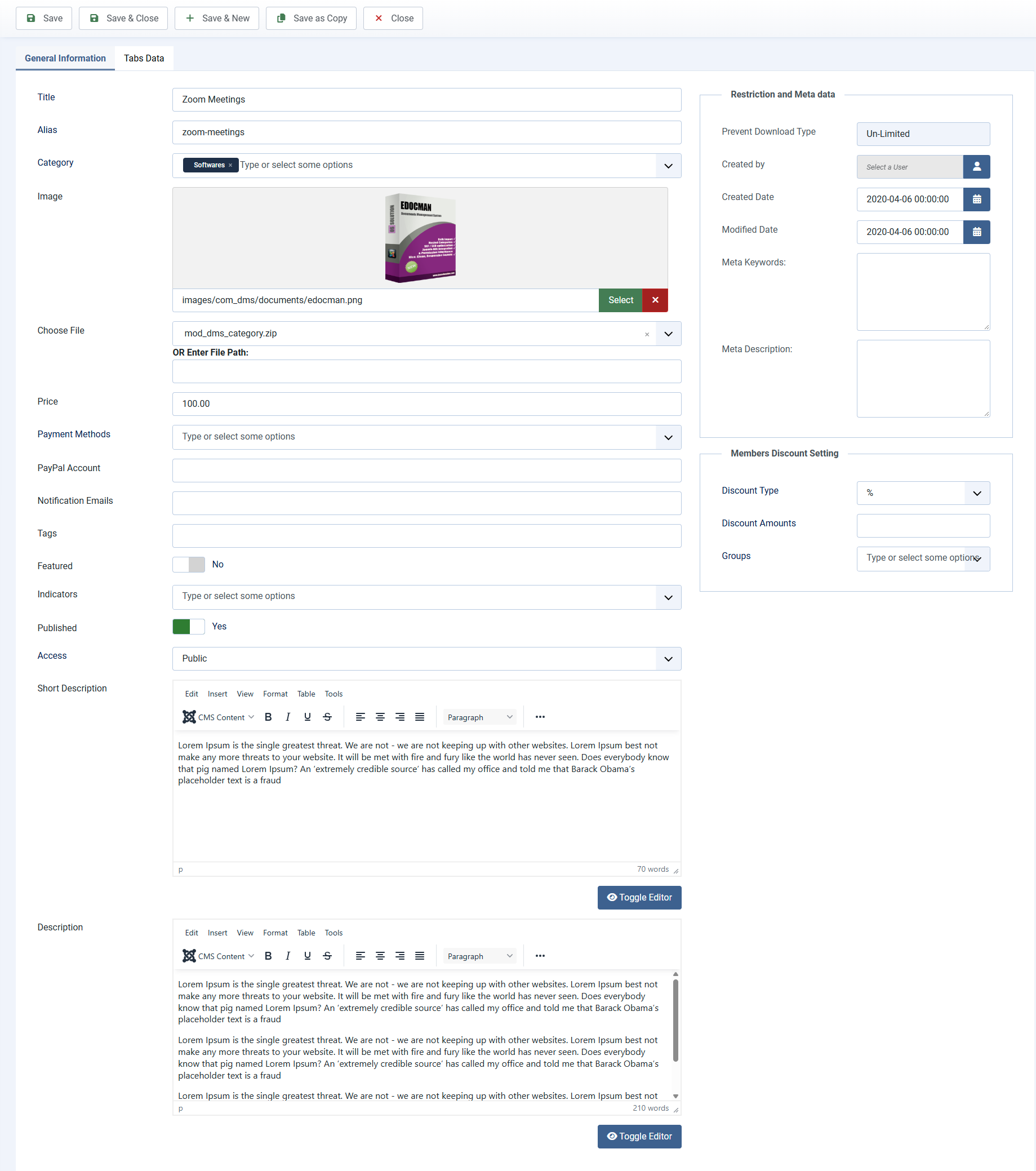
- On the General Information tab, enter a Title and select one or more published categories in Category. Leave Alias blank to generate it from the title for use in URLs.
- Select the download in Choose File. If the file is missing from the list, check that it is in the top level of Documents Path and that its extension is included in Allowed File Types. To use a file in a subfolder under Documents Path, enter its relative path in OR Enter File Path, for example
ebooks/guide.pdf. An entry in this field takes precedence over Choose File. - Enter a Price in your store currency. Use
0for a free download. Configure payment plugins for paid products or review the free download settings to decide whether visitors must sign in or complete a form. - Set Published to Yes and choose the Joomla viewing access level in Access. Use Public if guests should be able to see the listing in your catalog. Purchase access and free download access are configured separately.
- Click Save & Close. Open the document on your site from its category or through a Document Detail menu item, then check the order or download flow as a customer.
Describe the product
| Setting | How to use it |
|---|---|
| Short Description | Write a brief summary for storefront layouts that show a description in the product list. |
| Description | Explain what customers receive on the document detail page. Include details such as file formats, requirements, or licensing terms where relevant. |
| Image | Select a cover or preview image. If Resize Document Image is enabled, Documents Seller generates a thumbnail when you save. |
| Featured and Indicators | Mark a product as featured or add New and Hot labels in supported layouts. |
| Tags | Enter comma-separated tags to group related products by keyword. |
| Meta Keywords and Meta Description | Optionally set metadata for the document detail page under Restriction and Meta data. |
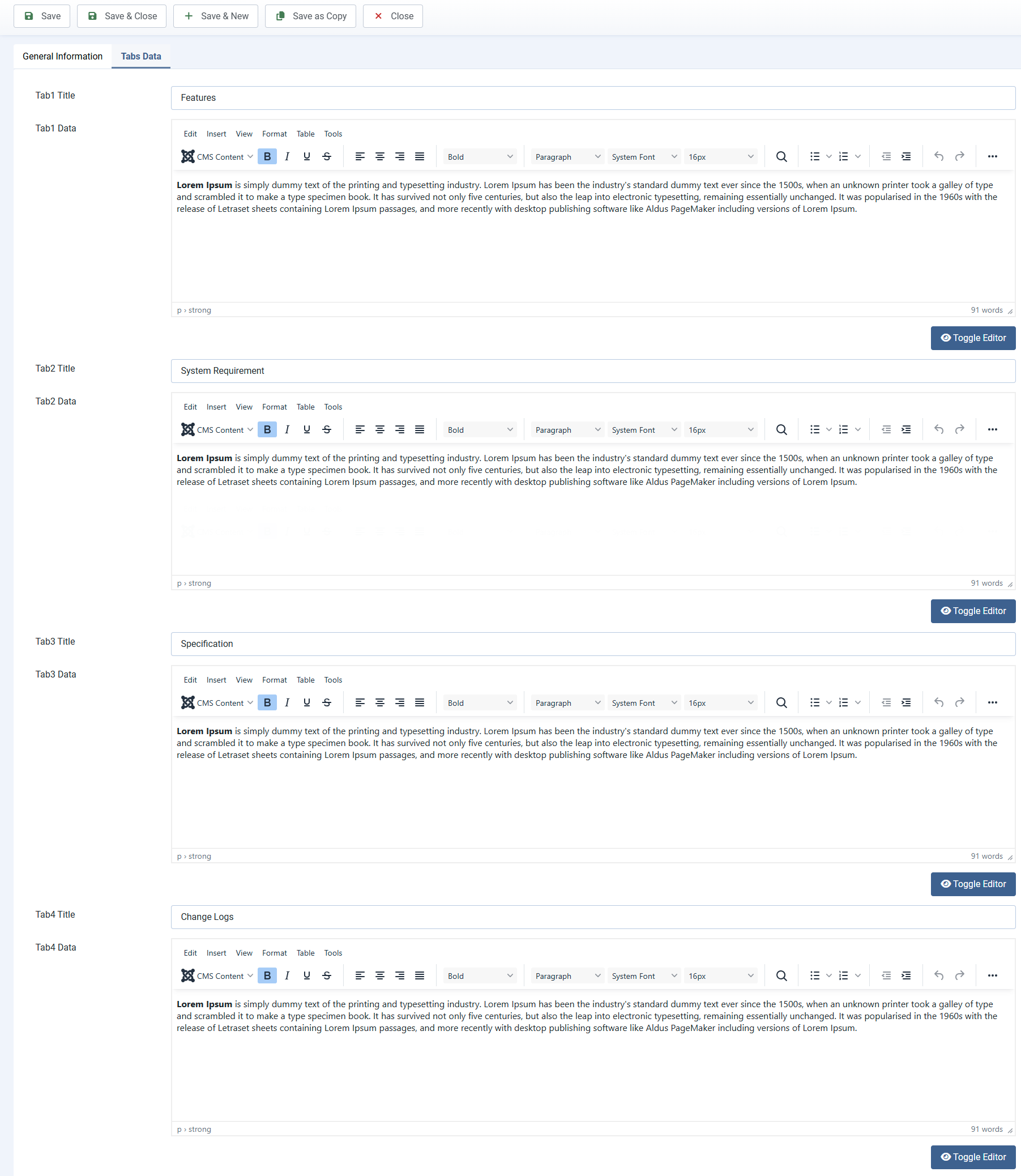
Use Tabs Data to organize additional information on the detail page, such as a table of contents, system requirements, or a changelog. Fill in Tab1 Title and Tab1 Data first, then add up to five more tabs. Each tab needs both a title and content to appear.
To let customers browse by tag, publish the tags module. In Documents Seller → Tags, you can see how often each tag has been used to open search results. To retire a tag, remove it from the documents that use it and delete it from the Tags list.
Limit downloads after purchase
Under Restriction and Meta data, choose a Prevent Download Type.
| Option | How it works |
|---|---|
| Un-Limited | Applies no per-document download limit. |
| After X downloads | Set Number Downloads to the maximum number of times the customer can download the document for that order. Downloads from the email link and Orders History count toward the same limit. |
| After X days | Set Number Days to the number of calendar days customers have to download the file after the order is paid or approved. |
If Download Link Valid In is also set, emailed download links must meet both that expiration and the document's own limit. Use download links or Orders History to enforce limits on access to the file. For email delivery, disable Send Documents Via Email to avoid sending a separate copy as an attachment. See Files, Downloads, and Emails.
Set product-specific checkout options
These fields appear when Activate Cart Feature is disabled and customers order one document at a time.
- Payment Methods limits checkout to the published payment methods you select. Leave it empty to offer all published methods.
- PayPal Account overrides the account configured in the os_paypal plugin for purchases of this document. Leave it empty to use the plugin's account.
- Notification Emails overrides the global recipients for administrator order notifications. Separate multiple addresses with commas.
Offer member discounts
Under Members Discount Setting, use Discount Type to choose a percentage or a fixed amount in the store currency. Enter the value in Discount Amounts. Choose Joomla user groups in Groups to limit the discount to signed-in members of those groups, or leave Groups empty to offer the discount to all signed-in users. For different amounts per group, enter one comma-separated value per group in the order the groups appear after saving. Customers who belong to several selected groups receive the largest applicable discount.
Offer updates for a Joomla extension
If this document is a Joomla extension that you sell, you can use Update Package to choose the ZIP that Joomla's updater installs on customer sites. See Joomla Extension Updates to upload the ZIP and connect the extension to Joomla's update system.
Manage documents
Go to Documents Seller → Documents to search for listings, filter by category or publication status, and open a document by clicking its title. Use the toolbar to publish, unpublish, or delete selected listings. To control the storefront sequence with the list's ordering controls, set the relevant storefront sort to Ordering.
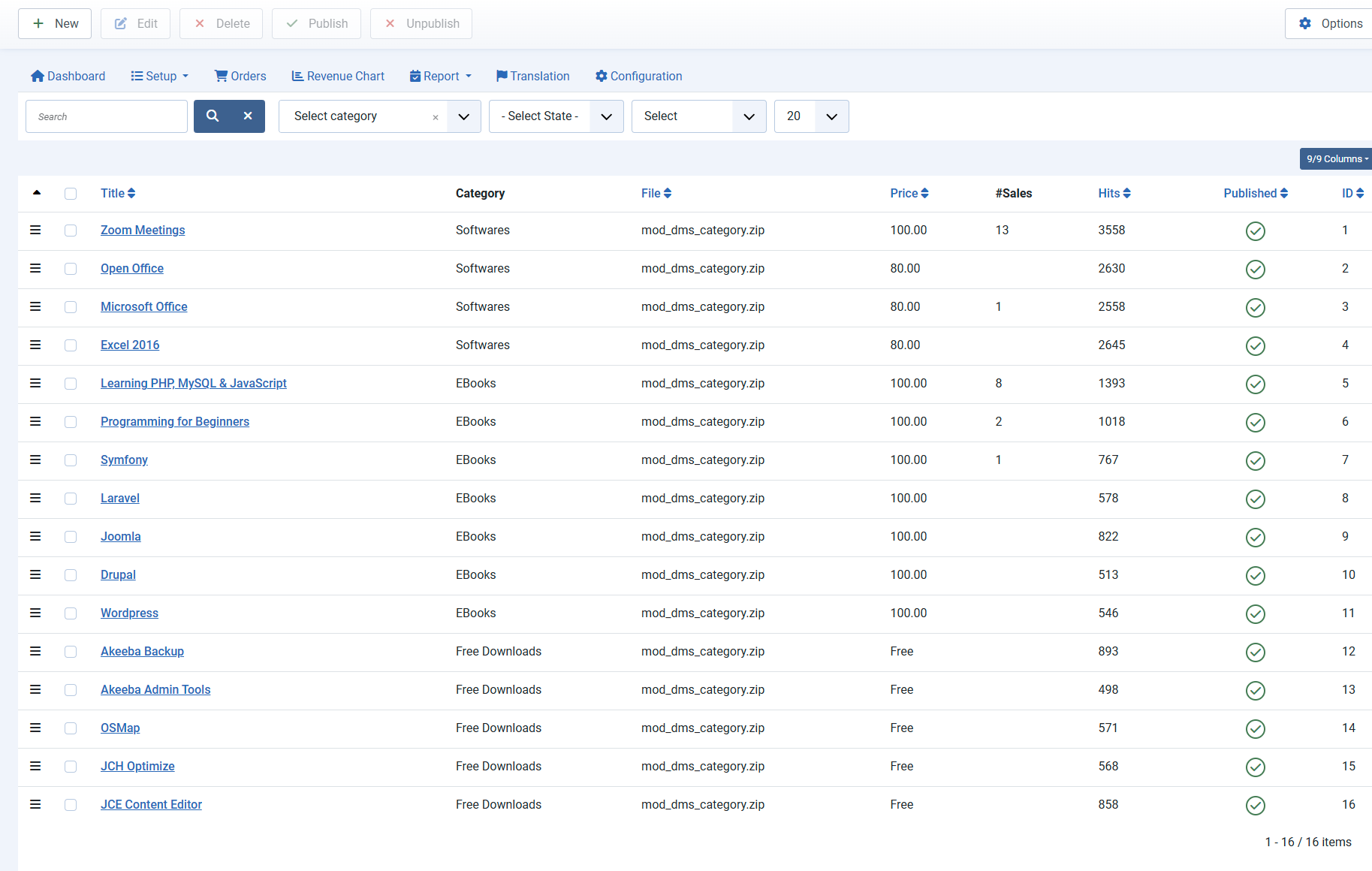
If the File column shows (File missing) for a local download, restore the file to its original location or edit the document and assign a replacement. Clear OR Enter File Path if you switch to a file from Choose File. Changing the file also changes what eligible customers with existing orders receive.
To hide a product from category listings while keeping existing orders downloadable, unpublish the document. If you created a Document Detail menu item for the product, unpublish that menu item too. Deleting the document removes the record existing orders use to find the file.