Orders Management
In the Joomla administrator, go to Documents Seller → Orders to find customer orders, record payments received outside checkout, and manage access to purchased documents. Open an order to edit it or issue a refund. Use the list toolbar to email customers or export order data.
Use the Revenue Chart to review revenue or order trends over a selected month range, compare with the previous year, and compare selected documents. Use the Sales Report for product sales and income based on order items. See Dashboard and Sales Charts for quick sales trends and store totals, or Scheduled Maintenance to clean up abandoned online payment orders.
Find and edit orders
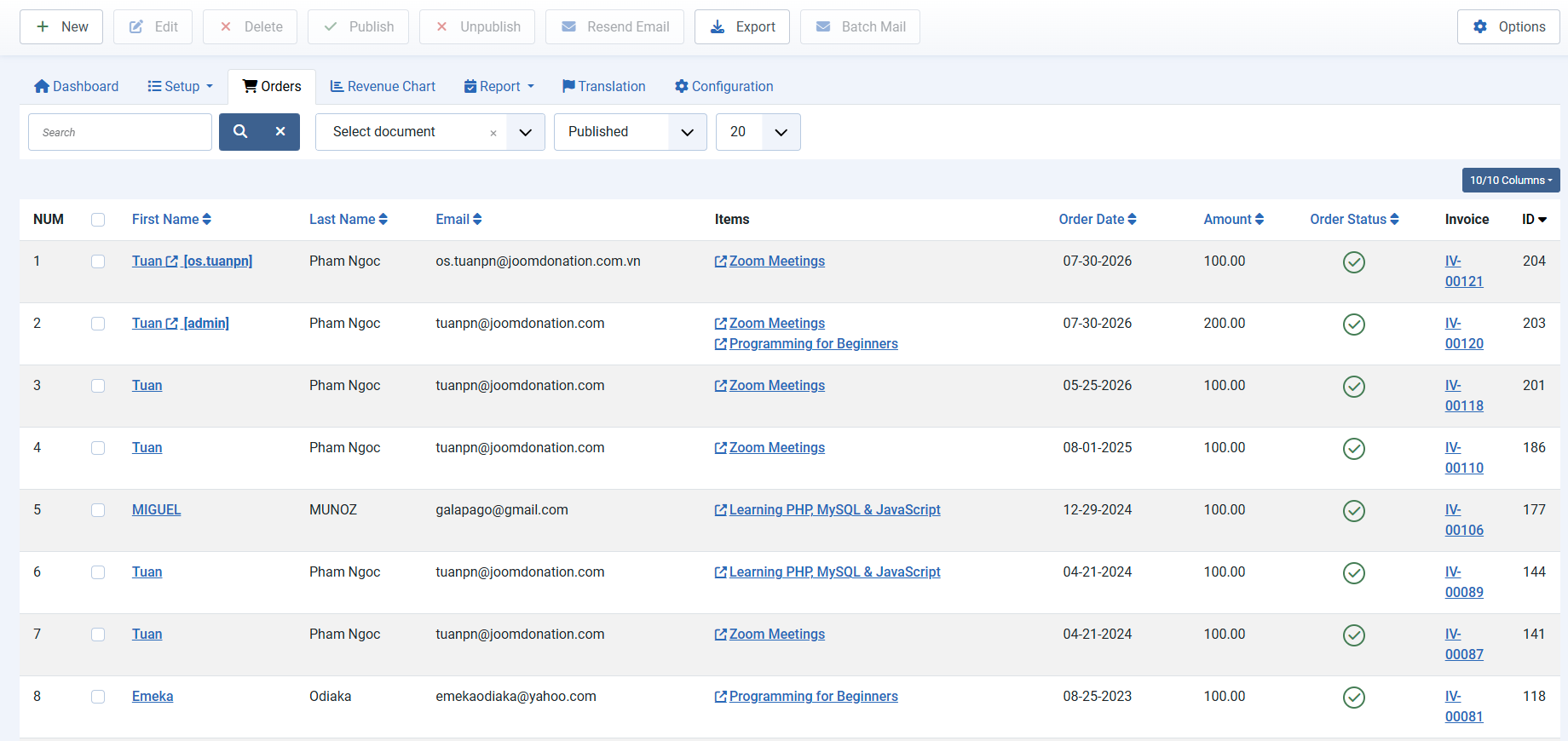
- Search by first name, last name, email address, Joomla username, or transaction ID. Enter
id:123to find order123oruser_id:42to find orders linked to Joomla user42. - Use Select document to find orders that contain a particular published document.
- By default, the list shows paid and refunded orders and pending offline orders. In Select State, choose Published for paid orders or Unpublished for pending orders, including incomplete online payments.
- Click the customer's first name to open an order. If invoicing is enabled, click the number in the Invoice column to download the PDF for an order with a positive amount and an invoice number. See Taxes and Invoices.
Add New Order
Create an order manually when a customer pays outside your site, such as by bank transfer without placing an order at checkout. The form records the payment details you enter.
- On the Orders page, click New.
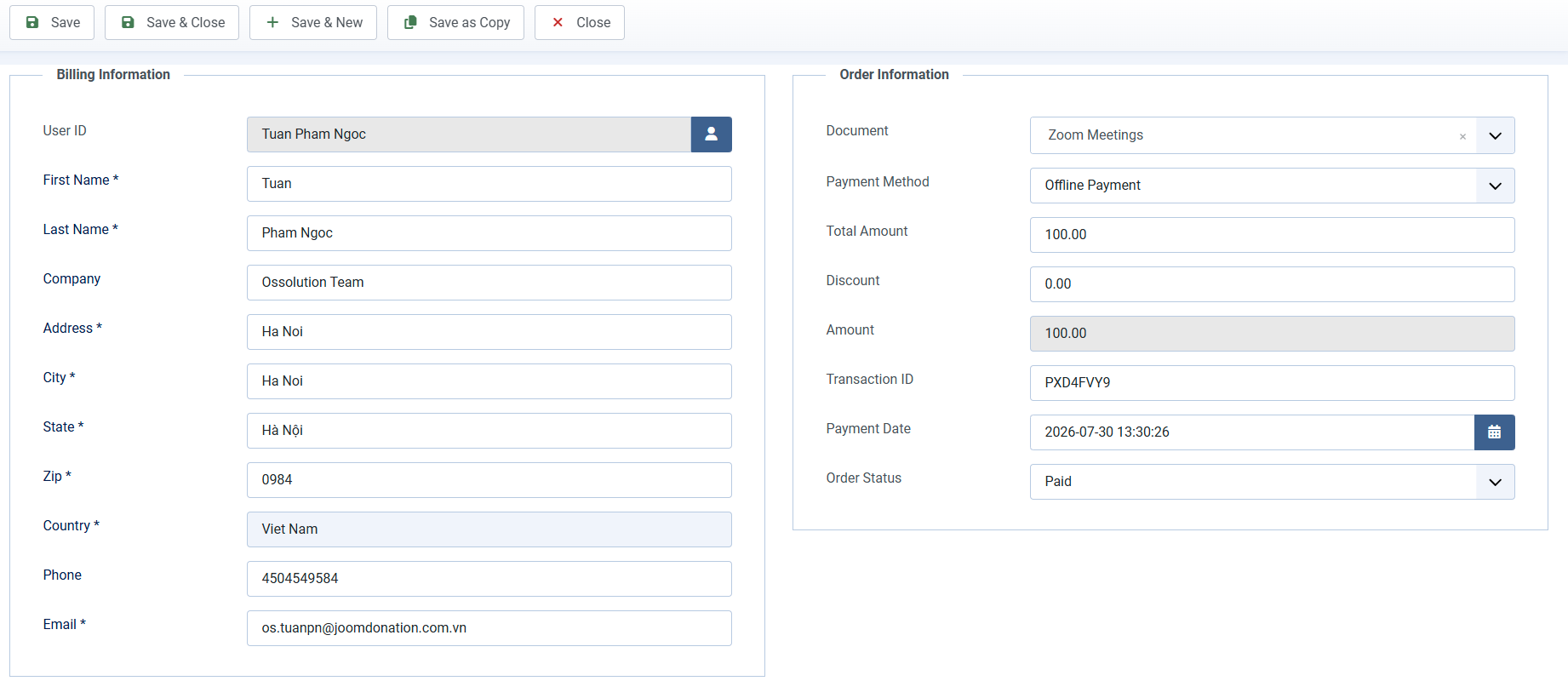
- Under Billing Information, select an existing Joomla account in User ID if you want to link the order to that customer. The selection fills in the name and email fields that are blank. Review the billing details and enter any remaining information.
- Under Order Information, select the purchased document and the Payment Method. You can select multiple documents when the shopping cart is enabled. The selectors list published documents and payment plugins.
- Enter the Total Amount before discounts and tax, any Discount, and the Tax Amount if the field is shown. On save, Documents Seller subtracts the discount and adds the tax to calculate the order amount. Enter the Transaction ID and adjust the Payment Date if you have those details.
- Set Order Status to Paid if you have received the payment or Pending if you are still waiting for it. Click Save & Close.
Creating an order with Paid status sends the corresponding customer confirmation email if its subject is configured.
Publish/Approve Order
After you receive payment for a pending offline order, mark it as paid in one of these ways.
- Select the order on the Orders page and click Publish, or click its unpublished icon in the Order Status column.
- Open the order, update the Transaction ID and Payment Date if needed, set Order Status to Paid, and save.
When a pending order becomes paid, Documents Seller sends the Order Approved Email if its subject is configured. It can include download links or attach the purchased files according to your delivery settings. Customers can also retrieve eligible downloads through a published Orders History menu item after signing in.
Use Unpublish to return a selected order to Pending and suspend access to its downloads. Delete removes the selected orders and their items from Documents Seller. Use the Refund action to send money back through a supported payment gateway.
Refund an order
Open the order, click Refund in the toolbar, and confirm. The action submits a refund for the order to its payment gateway. For refunds made directly in the gateway or through another channel, you can record the outcome by setting Order Status to Refunded and saving the order.
The Refund button is available for paid orders with a positive amount and a Transaction ID. Your Joomla account needs the Configure ACL & Options permission for Documents Seller, and the order's payment plugin must be published and configured to support refunds. For example, the PayPal plugin needs API credentials for the selected environment. The Authorize.Net plugin uses its API Login and Transaction Key.
After a successful refund through the toolbar, Documents Seller sets the order to Refunded and sends the Order Refunded Email if its subject is configured. The order's download links stop working and its items disappear from the customer's Orders History. Verify that the order shows Refunded after the action. If it still shows Paid, check the gateway's transaction record before retrying.
Resend Email
Select one or more orders and click Resend Email to send the customer email again. Documents Seller uses the current template for the order. It sends the free download confirmation for orders containing only free documents, the offline payment email for pending orders containing a paid document, and the order confirmation for paid orders containing a paid document. Administrator notifications are omitted. See Emails & Messages to edit the templates.
For a follow-up about a refunded order, use Batch Mail. Resend Email can send the standard order confirmation for a refunded order.
Batch Mail
Use Batch Mail to send a custom message about selected orders, such as letting buyers know that an updated file is available.
- Filter the Orders list if needed, then select the orders to email.
- Click Batch Mail and fill in both Subject and Message.
- Use tags such as
[FIRST_NAME],[LAST_NAME], and[EMAIL]in either field to personalize the message. Use[ITEM_NAME]for the first document name or[ORDER_DETAIL]in the message body for the full order summary. See Order tags. - Click Process to send the email.
Documents Seller sends one message per selected order to the email address saved on that order and skips invalid addresses. A customer with multiple selected orders can receive multiple messages.
Export orders
Apply any search, document, or state filters on the Orders page, then click Export to download order_list.csv. The file contains one row per matching order across all pages, regardless of which rows you select. Orders are sorted by ID in descending order.
The CSV includes the core billing fields, document names, subtotal, discount, final amount, order date, order status, transaction ID, and order ID. Tax Amount appears when the configured Tax Rate is greater than zero. The export omits extra custom fields.
The CSV labels both paid and refunded orders as Paid. Set Select State to Published before exporting if you want only orders that are currently paid.
Sales Report
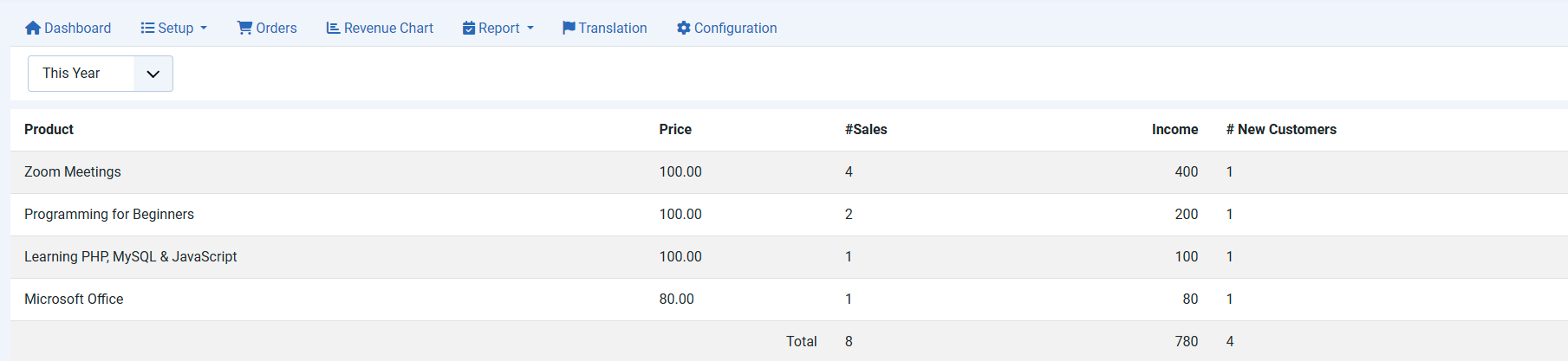
Go to Documents Seller → Sales Report and choose a reporting period. The available periods are Today, Yesterday, This Week, Last Week, Last 7 Days, This Month, Last Month, Last 30 Days, This Year, and Last Year. The report uses the order creation date.
The report shows each published document with sales in the chosen period. #Sales counts the order items for that document, Income adds up the prices recorded on those items, and # New Customers counts the orders flagged as coming from new customers. An order with multiple documents can contribute to more than one product row.
The report includes paid orders and pending offline orders, and excludes refunded orders. Income reflects item prices before order-level discounts and tax. Use the order export if you need the amounts recorded on individual orders.